Living and Working in the Space Between
Living and Working in the Space Between
The Shores Environment in Human Design represents the space between two worlds. People with this Environment are often naturally drawn to transitions, boundaries, and places where different perspectives meet. They have a particular ability to recognise possibilities that others may not yet be able to see.
Rather than pushing people towards immediate solutions, they often help others pause at a turning point. Somewhere between where they are now and where they could be heading. Their strength lies in creating awareness, offering a different perspective, and allowing new insights to emerge without forcing a particular outcome.
Within Human Design, Shores is one of the six Environment types and is associated with boundaries, transitions, and the meeting of different worlds. It describes the surroundings in which someone may feel most comfortable and supported, but it can also offer an interesting perspective on how they approach relationships, work, and personal development.
Shores Is About the Space Between Two Worlds
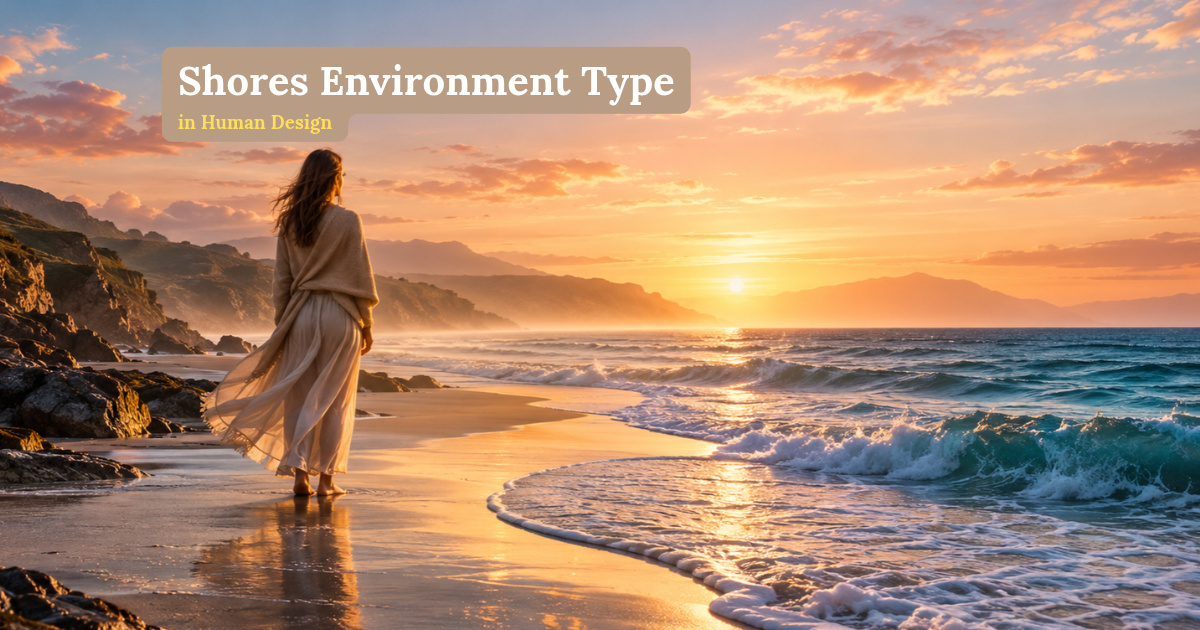
The image of a shoreline captures the essence of this Environment. It's the place where land meets water, where two completely different worlds come into contact without losing their individual nature.
Think of the transition between day and night, indoors and outdoors, or the familiar and the unknown. These are spaces where something is changing, but where the outcome has not yet been determined.
People with a Shores Environment may feel naturally comfortable in these transitional spaces. They don't necessarily need everything to be clearly defined or immediately resolved. Instead, they can recognise the value of remaining between two possibilities long enough to understand what each has to offer.
This ability can also influence the way they relate to other people. Where someone else might feel uncomfortable with uncertainty, a Shores person may see an opportunity to explore different perspectives.
They don't always need to choose between one position and another. Sometimes, the most valuable insights arise from recognising that both perspectives have something meaningful to contribute.
Creating Awareness Rather Than Providing Solutions
One of the interesting qualities associated with the Shores Environment is the ability to help others recognise possibilities beyond their current circumstances.
People with this Environment don't necessarily approach problems by immediately looking for practical solutions. Instead, they may ask questions that encourage someone to look at a situation from a different angle.
They understand that people sometimes become so absorbed in their circumstances that they lose sight of other possibilities. By introducing a different perspective, a Shores person can create the mental space needed for someone to discover their own answers.
This approach requires patience and an appreciation for nuance. Not every question needs an immediate answer, and not every situation can be reduced to a simple choice between right and wrong.
For Shores, the value often lies in the exploration itself, because a meaningful change in perspective can be far more powerful than advice someone isn't ready to apply.
Why Boundaries and Transitions Matter
The Shores Environment is closely associated with boundaries, but not necessarily in the sense of separation.
A shoreline is a boundary that also creates a meeting point. It allows two different environments to exist alongside each other while providing a place where interaction and exchange become possible.
For people with Shores, this can translate into an appreciation for situations where different ideas, experiences, or ways of living come together.
Some may enjoy physical environments that reflect this quality, such as coastal areas, waterfronts, balconies, terraces, or spaces connecting indoors and outdoors. Others may recognise the same principle in their preference for working between different disciplines, perspectives, or communities.
What matters within the Human Design interpretation is not simply being close to water, but experiencing an environment where different worlds meet.
These transitional spaces may help someone feel less confined to a single perspective and more open to exploring what lies beyond their immediate surroundings.
Shores in Business and Professional Life
In business, the qualities associated with the Shores Environment can create an approach that differs from conventional marketing and coaching models.
Traditional business advice often encourages entrepreneurs to define one specific niche, offer a clearly defined solution, and communicate a straightforward promise. While this approach can be effective, it may feel restrictive for someone who naturally works with nuance and different perspectives.
People with a Shores Environment may find that their greatest contribution doesn't always fit neatly into a predetermined process.
They might be particularly comfortable working with clients who are experiencing transitions, questioning established patterns, or considering a new direction in their personal or professional lives.
Rather than telling these clients exactly what to do, they can help them recognise possibilities that weren't previously obvious.
Their work may involve asking thoughtful questions, introducing alternative interpretations, or creating a setting in which people feel comfortable exploring uncertainty.
This doesn't mean they cannot offer structured services or clear guidance. It simply means that their most valuable contribution may lie in the perspective they bring rather than in promising a specific result.
Marketing Without Forcing a Fixed Message
Marketing can become challenging when someone feels pressured to simplify their work until its most meaningful qualities disappear.
For people with a Shores Environment, this may happen when they try to reduce a nuanced approach to a single promise or a rigid formula.
They may feel uncomfortable presenting themselves as someone who has all the answers, particularly when their natural strength lies in helping others discover answers for themselves.
A more suitable approach may involve communicating through thoughtful articles, personal observations, meaningful questions, and stories that encourage people to reconsider familiar assumptions.
Instead of constantly telling an audience what to think or do, they can offer perspectives that invite reflection.
This type of communication may attract people who are already questioning something in their lives and who appreciate an opportunity to explore different possibilities.
It may not appeal to everyone, but it doesn't have to. The goal isn't necessarily to reach the largest possible audience, but to communicate in a way that reflects the depth and character of their work.
Why Freedom and Flexibility Are Important
People with a Shores Environment may also appreciate a certain degree of freedom in how they organise their work.
They don't necessarily want to be restricted to one method, one perspective, or one way of approaching every situation.
Different clients and circumstances may call for different approaches, and having the flexibility to respond to those differences can make their work feel more natural.
This doesn't mean constantly changing direction or abandoning structure altogether. A clear framework can still provide stability while leaving enough room for individual circumstances.
The challenge is to find a balance between offering clarity and allowing possibilities to remain open.
When that balance is present, people with Shores may feel more comfortable expressing their own perspective without having to fit everything into a predefined formula.
When the Shores Environment Is Out of Balance
Within Human Design, the concept of a transfer state describes a situation in which someone moves away from their natural environmental alignment.
For people with a Shores Environment, this may become noticeable when they feel pressured to produce immediate answers, take action before a situation is fully understood, or reduce complex questions to overly simple solutions.
They may begin pushing themselves or others towards decisions before there has been enough opportunity to explore the different possibilities.
In business, this could mean following rigid marketing formulas, making promises that don't reflect their actual approach, or feeling compelled to offer a fixed solution to every client's problem.
Over time, this may create frustration because the freedom to explore different perspectives has gradually disappeared.
Within this interpretation, reconnecting with the qualities of Shores means allowing room for observation, reflection, and uncertainty.
Instead of immediately deciding what should happen next, it may be more useful to reconsider the situation, explore alternative perspectives, and allow a clearer direction to emerge naturally.
Shores Is About Recognising New Possibilities
The Shores Environment in Human Design is associated with the meeting of different worlds and the possibilities that emerge when familiar boundaries are approached from a new perspective.
People with this Environment may have a natural appreciation for transitions and situations where nothing has been fully decided yet. They can recognise that uncertainty doesn't always need to be eliminated immediately, because the space between two possibilities can offer valuable insights of its own.
In their relationships, professional activities, and personal development, this perspective may help them create an atmosphere where others feel free to question assumptions and consider different directions.
Their contribution doesn't necessarily lie in guiding someone through every stage of a transformation. Sometimes, their greatest value is found in a single conversation or observation that helps another person recognise something they couldn't see before.
The essence of Shores isn't about pushing people towards a particular destination. It's about standing at the boundary between what is familiar and what remains possible, allowing both perspectives to exist long enough for something new to become visible.
And sometimes, that change in perspective is exactly what someone needs before they can take their next step.