Space, Perspective, and Working with the Bigger Picture
What Does the Markets Environment Mean in Human Design?
The Markets Environment in Human Design describes the conditions in which you may feel most comfortable and supported. It is associated with discernment, conscious choices, and the ability to recognise what genuinely fits your needs, both in everyday life and in business. Markets is one of the six Environments and belongs to what are known as the conditions. This means that, within the Human Design framework, this environment is considered more than just a personal preference. It plays an important role in your well-being and the way you function.
People with a Markets Environment often have a keen eye for detail. They notice subtle differences that others may completely overlook. They can recognise the difference between something that is good and something that is truly exceptional. This sensitivity to quality can be reflected in their work, their choices, their relationships, and even the way they communicate.
They aren't selective simply because they're difficult to please. They're selective because their system is constantly gathering information about quality, alignment, and what feels right.
Seeing Life Through a Filter of Quality
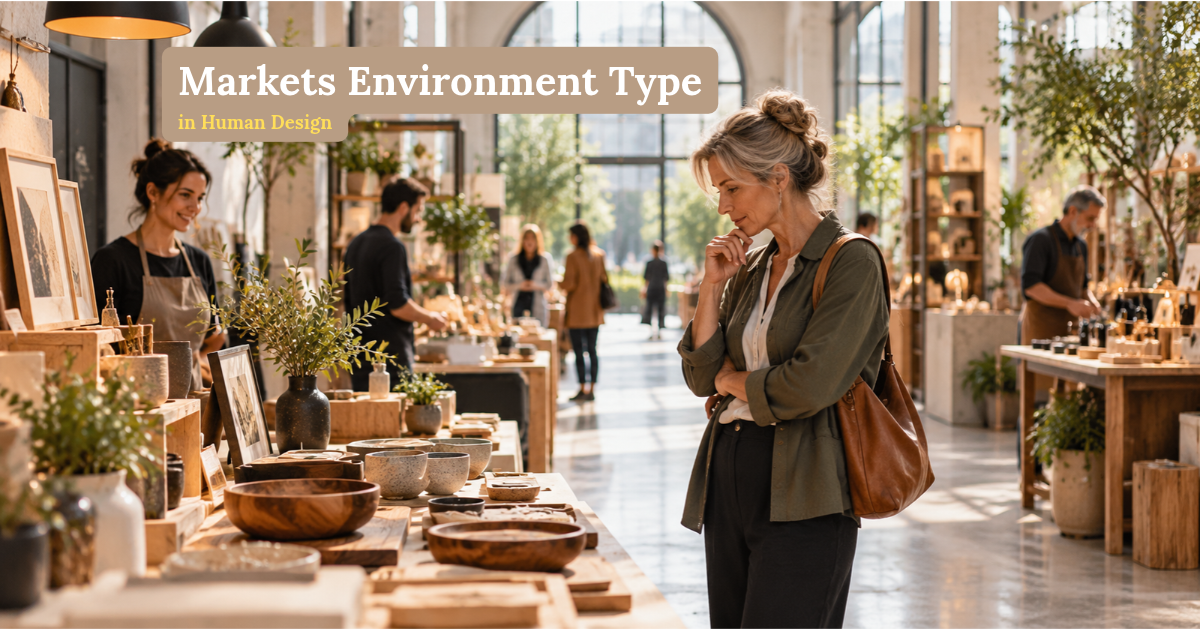
The image of a marketplace captures the nature of this Environment particularly well. Imagine walking through an artisan market where different vendors display their finest products. You wander around, observe, compare, taste, and discover what appeals to you. You don't buy everything you see. You make conscious choices.
This is how many people with a Markets Environment approach life.
They often have an intuitive sense of what suits them and what doesn't. Which clients feel like a good match, which projects energise them, which collaborations flow naturally, and which opportunities simply aren't worth their time or attention.
For them, discernment is more than a personality trait. It's an inner compass.
Change Is Part of Their Natural Rhythm
One of the most important characteristics of this Environment is the understanding that not everything is meant to last forever. People with a Markets Environment often move through distinct phases in their personal and professional lives.
They may feel enthusiastic about a particular service, platform, target audience, or way of working for quite some time. Then, at a certain point, something shifts. What once felt energising suddenly becomes heavy, uninspiring, or no longer satisfying.
This doesn't necessarily mean they've lost interest or that they're inconsistent.
It may simply mean that a particular chapter has come to an end.
Many people with a Markets Environment struggle with this because they've been taught that success means sticking to the same approach indefinitely. Yet their natural rhythm may work differently. What feels right today won't necessarily be the right choice two years from now.
Why Trusting Your Instincts Matters
People with a Markets Environment often have a particularly refined sense of alignment. They can recognise when something still feels alive and meaningful, and when it has reached the end of its usefulness.
Yet many people ignore those signals.
They continue offering services that no longer inspire them, remain active on platforms that drain their energy, or keep working with clients who are no longer a good fit.
This often happens because they're afraid of losing income or because they believe they should simply persevere.
But the longer someone with a Markets Environment works against their natural rhythm, the greater the chance of experiencing frustration, fatigue, or resistance. Their body may give them clear signals when something no longer feels right.
Markets in Business
In business, this Environment can be a tremendous strength. People with a Markets Environment often have a sharp eye for quality. They notice details that others miss and quickly recognise where improvements could be made.
Their clients generally appreciate their precision, attention to nuance, and ability to offer solutions tailored to individual needs.
They're rarely satisfied with generic solutions or superficial programmes. Instead, they look at each client's unique circumstances and adapt their approach accordingly.
As a result, they may attract clients who also value quality and are willing to invest in something that genuinely meets their needs.
Why Flexibility Matters More Than Consistency
A great deal of marketing advice is built around constant repetition. Keep doing the same things, communicate the same message, and remain visible on the same platforms.
For people with a Markets Environment, this approach doesn't always work.
Their energy tends to thrive when they have room for choice and variety. They often feel more comfortable when they can respond to what feels relevant and engaging at a particular moment.
This doesn't mean they should act impulsively. It means allowing themselves the freedom to evolve.
Sometimes that involves adjusting a service, exploring a new subject, or stepping away from a platform where they've been active for years.
Their strength doesn't lie in rigidly holding on to what they've always done, but in making conscious choices about what still serves them.
When the Markets Environment Is Out of Balance
In Human Design, there's a concept known as the transfer state. This describes a condition in which someone moves away from their natural environmental alignment.
For people with a Markets Environment, this can happen when they continue holding on to something they already sense is no longer right for them.
They keep posting on a platform that leaves them exhausted, continue offering a service they no longer feel passionate about, or seek external validation instead of trusting their own discernment.
The longer this continues, the more draining it can become.
The answer usually isn't to work harder, but to reconnect with what genuinely feels right. To create enough space to recognise what still nourishes them and what has simply run its course.
Markets Is About Making Conscious Choices
People with a Markets Environment aren't here to do everything for everyone. Their strength lies in their ability to select, refine, and recognise quality.
They often have a remarkable sense of what is appropriate for a particular moment, situation, or person.
When they learn to trust that discernment, they may experience greater calm, clarity, and satisfaction in their work and everyday life. Not because they work harder than everyone else, but because they become more intentional about choosing what genuinely suits them.
Their greatest talent isn't doing more.
It's knowing what is worth keeping and what they can allow themselves to let go of.