Why Choosing the Right Human Design Book Matters
If you have recently discovered Human Design, you have probably noticed how much information is available. Websites explain the different Types, social media posts describe personality characteristics associated with Profiles and Gates, and automated reports promise to reveal everything about your personal BodyGraph.
There are also numerous Human Design books, ranging from simple introductions to extensive reference works containing hundreds of pages of technical information. For someone who is just beginning to explore the system, choosing the right book can be surprisingly difficult.
The first question I would ask is what you actually want to learn.
Are you trying to understand the basic principles of Human Design? Do you want to explore your own chart in greater detail? Are you interested in analysing the charts of friends, family members or clients? Or are you looking for a reference that will remain useful as your knowledge develops?
These are very different objectives, and not every Human Design book serves the same purpose.
I also think it is important to distinguish between collecting information and understanding it. You can own several books, memorise the descriptions of the different Types and recognise dozens of Keynotes without necessarily understanding how the individual elements of a BodyGraph influence one another.
That distinction becomes particularly important when you move beyond your own chart.
What Can You Learn from a Human Design Book?
Human Design is a system developed by Ra Uru Hu that combines concepts from several traditions, including astrology, the I Ching, the chakra system and the Kabbalah.
Within its own framework, Human Design uses birth information to calculate a BodyGraph consisting of nine Centers, 36 Channels and 64 Gates, together with conscious and unconscious planetary activations.
The system also introduces Type, Strategy, Authority, Profile, Definition and several additional layers of interpretation.
A good introductory Human Design book should help you become familiar with these elements without overwhelming you with technical details.
It should explain how a BodyGraph is constructed, why the different Centers are connected through Channels and what the distinction between Defined, Undefined and Open Centers means within Human Design.
Understanding the relationship between Type, Strategy and Authority is another important part of this foundation.
However, a book that explains the individual components does not necessarily teach you how to interpret a complete chart.
For that, you need to understand how those components interact.
A Gate has its own Keynotes, but its mechanical role depends partly on whether it forms a complete Channel or remains a hanging Gate. A Channel contributes to the Definition of a chart, while the circuitry introduces additional themes into the interpretation.
The Profile, Authority and conscious and unconscious activations add further context.
This is why I consider learning the structure of Human Design at least as important as memorising its terminology.
Beginner Human Design Books: Learning the Foundations
If you are completely new to Human Design, I would not recommend starting with a complicated technical reference containing descriptions of all 64 Gates and their individual Lines.
Without understanding the basic structure, those descriptions can quickly become a confusing collection of unfamiliar terms.
An introductory book should first help you recognise the main elements of your BodyGraph.
You need to understand what the nine Centers represent, how Definition is created, why some Centers remain Undefined and what determines your Type.
Once these foundations are clear, the concepts of Strategy and Authority become easier to place within the wider system.
This is the approach I take in my book Human Design Ontrafeld, which was written to explain Human Design in accessible language while retaining the underlying mechanics.
My intention was to make the system understandable without reducing it to a series of personality labels.
For example, learning that someone is a Projector tells us something about their Type and Strategy within Human Design, but it does not describe their entire personality. Their Authority, Definition, Profile and the configuration of their Channels introduce distinctions that a general Type description cannot explain.
The same principle applies to Generators, Manifesting Generators, Manifestors and Reflectors.
An introductory book should therefore provide enough background to understand why these distinctions matter before moving into more specialised subjects.
Once you can recognise the basic structure of a chart, a more comprehensive reference work becomes considerably more useful.
Why a Human Design Keynotes Book Is Different
A Keynotes book serves another purpose.
Rather than guiding you through the basic principles from beginning to end, it provides a reference you can consult whenever you encounter a particular element in a BodyGraph.
Keynotes are concise descriptions of the functions, qualities or themes associated with different Human Design components.
They form an essential part of the system's vocabulary.
When studying a particular Gate, for example, you can consult its Keynotes to understand the themes associated with that activation. You can then examine the Channel it belongs to, the circuitry involved and the way the activation relates to other elements in the chart.
The important difference is that a comprehensive Keynotes reference is not limited to your personal BodyGraph.
An automated report usually contains descriptions selected according to your birth information. If a Gate is not activated in your chart, its description may not appear in the report at all.
That makes sense when the purpose is to introduce someone to their own design, but it also creates a limitation for people who want to study Human Design more broadly.
Imagine that you want to examine the chart of your partner, your child or a friend. Their BodyGraph may contain completely different Channels, Gates and Profiles from yours.
The information in your personal report will not necessarily cover those elements.
With a complete Keynotes reference, you can look them up without ordering another personalised report simply to obtain descriptions that were missing from the first one.
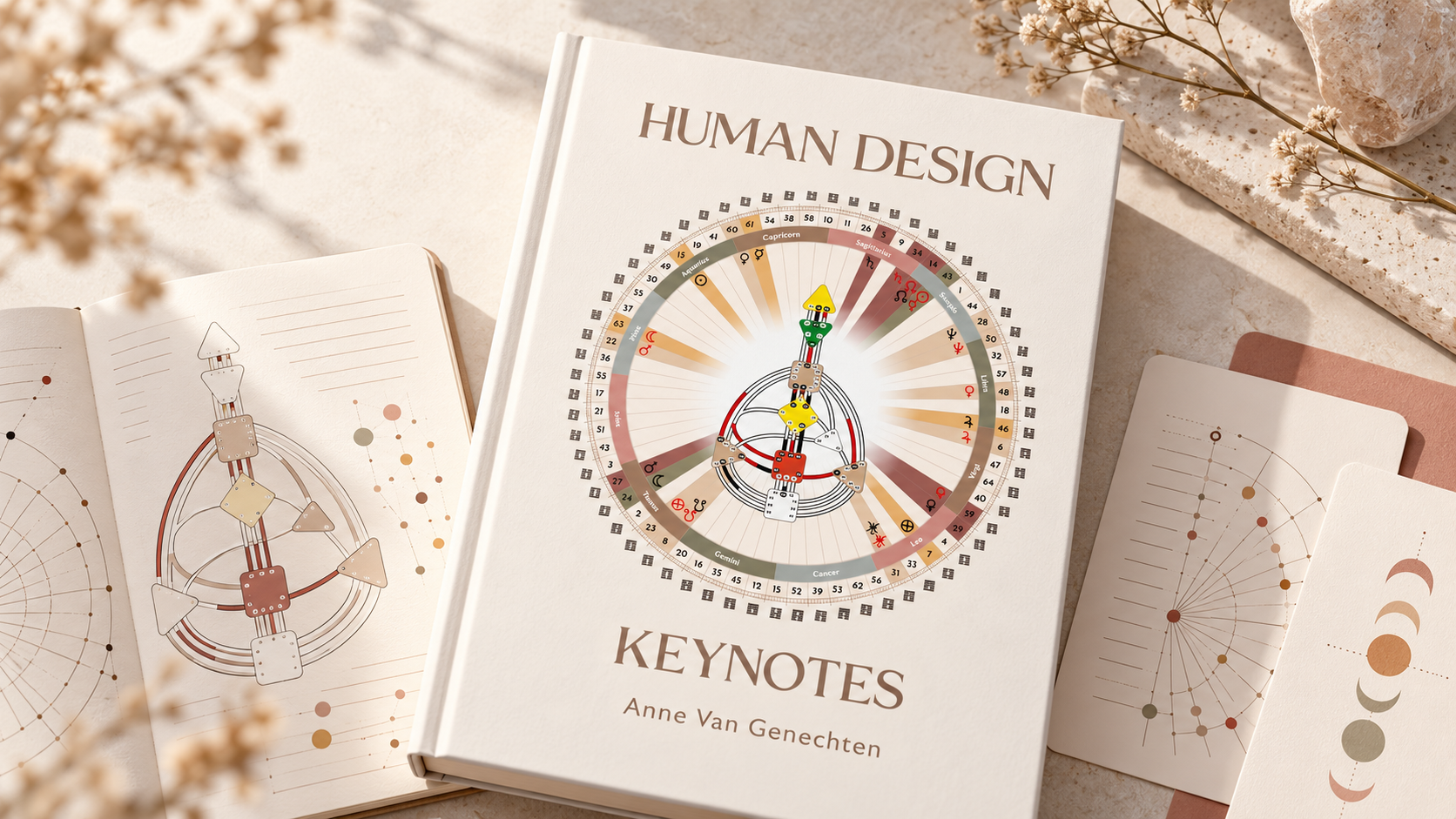
This is why I wrote Human Design Keynotes as a reference work for people who want to move beyond the information contained in their own chart.
It brings the individual Keynotes together in one place, making it possible to examine different configurations and return to particular descriptions whenever you need them.
For someone who enjoys studying Human Design independently, that can be far more practical than accumulating separate automated reports.
Human Design Books Versus Automated Reports
The popularity of Human Design has created an enormous market for automatically generated reports.
Many of these reports are beautifully designed and contain extensive descriptions of the individual's Type, Profile, Authority, Centers, Channels, Gates and Incarnation Cross.
I don't consider this a negative development in itself. Automated reports can make Human Design accessible to people who might otherwise find its terminology difficult to understand.
They also offer a convenient introduction to the individual elements of a personal BodyGraph.
However, the amount of information in a report should not be confused with the depth of its interpretation.
Most automated reports are assembled from predefined descriptions stored in a database. The relevant texts are selected according to the elements present in someone's chart and combined into a personalised document.
That approach can produce a detailed report, but it does not automatically explain the relationships between the different components.
Someone may receive several pages about their Split Definition, another section describing their Channels and additional explanations about the Gates involved, without being shown how those particular elements interact within the complete configuration.
The descriptions may all be correct within the terminology of Human Design, yet the reader can still struggle to understand the overall mechanics.
Some advanced automated reports also include interpretations of combinations and interactions, so it would be incorrect to suggest that every automated report is equally limited.
Nevertheless, if your main objective is to learn the Keynotes themselves, purchasing a comprehensive reference book can be a more versatile choice.
Instead of receiving descriptions selected exclusively for your personal chart, you gain access to information you can use when examining many different BodyGraphs.
The difference becomes even more significant when Human Design develops from a personal interest into a subject you want to study seriously.
Can You Learn to Read Human Design Charts from Books?
You can certainly acquire a great deal of knowledge through books, particularly if you approach Human Design systematically.
However, there is a considerable difference between recognising the elements of a chart and understanding how they function together.
Think of learning a language.
Knowing the meaning of individual words is necessary, but understanding an entire conversation requires knowledge of grammar, context and the relationships between those words.
Human Design works in a similar way within its own interpretive framework.
You may know the Keynotes of a particular Gate, but you must also understand its position within the BodyGraph, whether it forms part of a Defined Channel and how that Channel contributes to the overall Definition.
The nine Centers introduce another layer of interpretation.
A Defined Center represents a consistent energetic function within Human Design, while an Undefined or Open Center is considered receptive to influences from the environment.
But knowing that distinction is only the beginning.
The activated Gates within an Undefined Center, the hanging Gates elsewhere in the chart and the connections that may arise through interaction with another person all influence the interpretation.
Circuitry introduces additional themes, while the conscious and unconscious activations contribute further distinctions.
This means that two people sharing the same Type and Profile can have substantially different BodyGraphs.
A meaningful reading must take those individual differences into account.
Books can teach you the terminology, explain the mechanics and provide examples of how the different elements are connected. Developing the ability to interpret an entire chart, however, requires practice, careful observation and continued study.
That is why I regard a Keynotes reference as an important tool rather than a substitute for learning the underlying structure.
Why Understanding the Connections Matters More Than Memorising Keynotes
One of the misconceptions reinforced by simplified Human Design content is that every element of a chart can be interpreted separately.
Someone reads a description of their Type and assumes it tells them who they are. Another person discovers a particular Gate and begins identifying with every characteristic associated with it.
This approach overlooks the relationships between the different elements.
Consider someone with a Split Definition.
Their BodyGraph contains two separate areas of Definition, meaning that the Defined Centers form two distinct connected groups.
A general explanation of Split Definition introduces the concept, but it does not tell us where those two areas are located or which connections might bridge them.
To examine that, we need to look at the Gates, Channels and overall configuration of the individual chart.
The situation becomes even more interesting when studying relationships.
Another person may carry activations that create additional connections when both BodyGraphs are considered together. These interactions form part of the Human Design approach to understanding conditioning and relationship dynamics.
Yet the significance of those connections cannot be understood through isolated Keynotes alone.
This is precisely why having access to all the relevant descriptions is useful, but never sufficient by itself.
A complete reference provides the vocabulary. Knowledge of the mechanics helps you understand how that vocabulary is used.
When both are combined, you can begin examining BodyGraphs with greater attention to their individual structure rather than relying on broad descriptions associated with a Type or Profile.
When Is a Personalised Deep Reading More Useful Than Another Book?
Although I believe books are valuable tools for studying Human Design, not everyone wants to learn how to analyse a BodyGraph independently.
Some people are primarily interested in understanding their own design.
They may already have an automated report and recognise themselves in various descriptions, but struggle to understand how the different elements relate to one another.
Others encounter apparently contradictory themes in their chart or have questions about their decision-making patterns, relationships or the way they respond to external expectations.
For these readers, purchasing another introductory book may not provide the specific explanation they are looking for.
A personalised Deep Reading offers a different approach.
Rather than repeating the individual Keynotes, it examines how the Centers, Channels, Gates, Definition, Authority, Profile and other relevant elements function together within the complete BodyGraph.
The purpose is to bring the separate descriptions into a coherent interpretation of the individual configuration.
For example, knowing that someone has Emotional Authority is only one part of the information contained in their chart. Understanding how that Authority relates to their Definition, Channels and other activations requires examining the broader structure.
A Deep Reading can also explore conditioning themes and the areas where an individual's experience may be influenced by interactions with others.
This does not mean that Human Design provides scientifically established explanations for personality or behaviour. The system has not been validated as a psychological assessment method, and its interpretations should be approached as a framework for reflection rather than proven facts.
Nevertheless, someone who wishes to explore Human Design may find a personalised analysis more helpful than another collection of general descriptions.
The choice depends on whether you want to develop your own knowledge of the system or receive a more integrated interpretation of your personal BodyGraph.
Which Human Design Book Should You Choose?
I would begin by considering how far you want to take your interest in Human Design.
If you are new to the system, an accessible introductory book such as Human Design Ontrafeld can help you understand the terminology and the basic mechanics of the BodyGraph.
Once you have that foundation, Human Design Keynotes becomes a useful reference for exploring individual elements in greater detail and examining configurations beyond your own chart.
The two books serve different purposes, but they also complement one another.
The introductory book explains how the system is constructed and how its principal components relate to one another. The Keynotes reference allows you to consult the descriptions associated with different elements whenever you are analysing a chart.
If you intend to study Human Design seriously, having both kinds of information available can make your learning process more structured.
And if your primary interest is understanding your own BodyGraph without undertaking extensive study, a personalised Deep Reading may be the more appropriate choice.
There is no need to purchase multiple reports simply to collect additional descriptions, particularly when a comprehensive reference work already provides access to the individual Keynotes.
What matters is understanding what you are buying and what kind of knowledge it can realistically provide.
Human Design Books Are Tools for Learning, Not Collections of Labels
I think one of the greatest difficulties with the current popularity of Human Design is the tendency to reduce its concepts to easily recognisable labels.
People become familiar with their Type, discover a few characteristics associated with their Profile and begin interpreting their behaviour through short descriptions found online.
Books can either reinforce that tendency or encourage readers to examine the system more carefully.
A useful Human Design book should make you curious about the relationships between the different elements rather than convince you that a single label explains your entire personality.
It should help you distinguish between the Keynotes of an individual Gate and the mechanical role that Gate plays within a complete BodyGraph.
It should also make clear that an interpretation is not the same as a prediction, and that personal recognition does not constitute scientific proof.
For me, studying Human Design has always been about understanding the structure behind the descriptions.
The more familiar you become with the connections between Centers, Channels, Gates, Circuits and Definition, the more apparent it becomes why isolated Keynotes cannot provide a complete interpretation.
Having a reliable reference at hand makes that study easier, particularly when you begin comparing charts and encounter configurations that differ from your own.
But the real progress comes from learning to connect the information rather than simply accumulating more of it.
If you are interested in exploring Human Design beyond the descriptions in your personal report, you can discover my book Human Design Keynotes in the Human Design bookshop.
And if you already have a report but would prefer someone to explain how the different elements of your own BodyGraph work together, you can explore my personalised Deep Reading.
Ultimately, the most useful Human Design book is not necessarily the one containing the greatest number of pages or the longest descriptions. It is the one that helps you understand the subject more clearly and gives you the knowledge you need for the next stage of your exploration.