More Than Just a Label
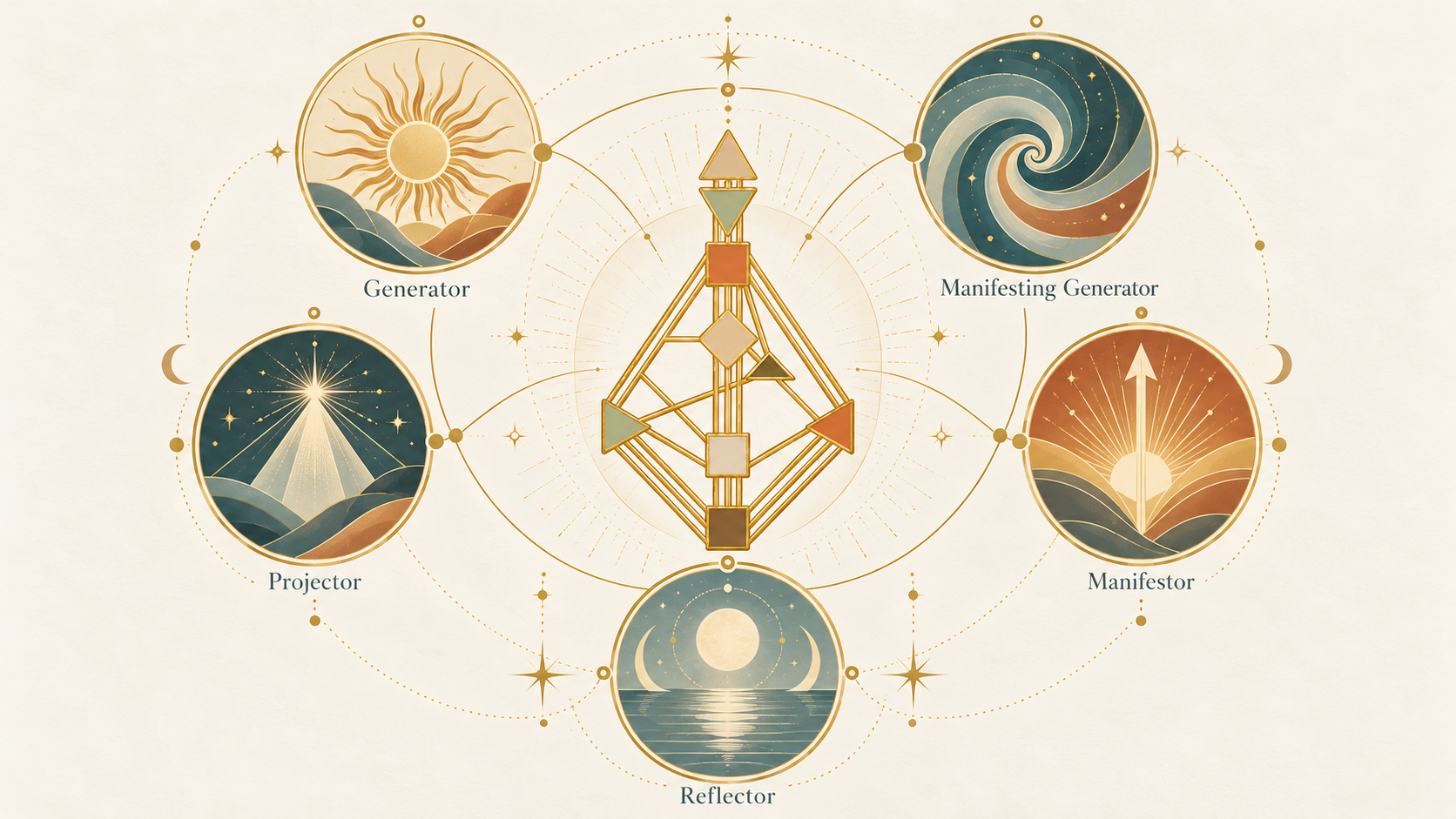
When people first discover Human Design, one of the first things they want to know is their Type. They enter their birth details into a chart generator and discover that they are a Generator, Manifesting Generator, Projector, Manifestor or Reflector.
What usually follows is a search for information about what that Type means. There are countless descriptions online, many of them offering simple rules about how people should live, work, make decisions or interact with others. And while these descriptions can be an interesting introduction, they sometimes create more confusion than understanding.
The five Human Design Types are commonly presented as five different ways of interacting with the world. But understanding your Type involves more than identifying with a list of personality traits. Within Human Design, Type is determined by the configuration of your BodyGraph, particularly the definition of certain Centers and the connections between them.
Your Type is therefore not something you choose based on your personality or how you happen to feel. It is calculated from your birth information according to the rules of the Human Design system.
Let's look at what distinguishes the five Types and why understanding these differences can offer an interesting starting point for exploring your own chart.
Are There Four or Five Human Design Types?
Before discussing the individual Types, there is one distinction worth making.
In the original Human Design teachings, there are four fundamental Types: Generator, Manifestor, Projector and Reflector. Manifesting Generators belong to the Generator family because they have a defined Sacral Center, but their chart also includes a motor connection to the Throat Center.
Today, many websites and chart generators present Manifesting Generators separately, which is why you'll frequently encounter descriptions of five Human Design Types.
Both ways of presenting the information refer to the same underlying chart configurations. The difference lies in whether Manifesting Generators are discussed as a separate category or as a variation within the Generator Type.
For this article, we'll look at all five individually.
The Generator: Learning to Recognise What Deserves Your Energy
Generators are characterised by a defined Sacral Center. Within Human Design, this Center is associated with a consistent source of life-force energy, particularly when a person is engaged in activities that genuinely interest them.
The Generator Strategy is to respond.
This doesn't mean sitting around waiting for someone to tell you what to do. Rather, it refers to noticing what life presents and observing your response before committing your energy.
Consider someone who has spent years accepting responsibilities simply because they are capable of handling them. They might be exceptionally productive, reliable and willing to work hard, yet find little satisfaction in what they actually do.
Within Human Design, the Generator's experience of frustration is associated with situations in which energy is repeatedly committed without a genuine response.
Satisfaction, on the other hand, is described as the Generator's Signature, a sign within the system that their energy is being used in a fulfilling way.
The interesting question isn't whether a Generator can work hard. It's whether all that effort is being directed towards something they actually want to engage with.
Of course, not every Generator experiences decision-making in the same way. A Generator with Emotional Authority, for example, has a different decision-making process from someone with Sacral Authority.
That distinction matters because Type and Authority are intended to be understood together.
The Manifesting Generator: Responding Without Following a Straight Line
Manifesting Generators share the Generator's defined Sacral Center, but their configuration also includes a motor connection to the Throat.
They are commonly described as people who move quickly, explore several interests and sometimes reach their destination by taking a less conventional route.
But this description can be misleading when it becomes a stereotype.
Not every Manifesting Generator is constantly busy, impatient or managing several projects at once. The particular way someone expresses their energy depends on the rest of their chart and, naturally, on their circumstances and personal experiences.
Like other Generators, Manifesting Generators have a Strategy of responding. Their manifesting potential doesn't eliminate the importance of that response.
Within the system, frustration is associated with the Generator family, while Manifesting Generators may also recognise anger when they encounter resistance.
Imagine someone who becomes enthusiastic about a new project, discovers halfway through that a different approach would work better and changes direction without feeling the need to follow the original plan.
Other people may interpret that behaviour as inconsistent. From a Human Design perspective, however, the emphasis is on recognising what genuinely engages their energy rather than insisting that every process must unfold in a predetermined sequence.
The practical question for a Manifesting Generator is not how to become faster or more productive, but how to distinguish genuine engagement from activity undertaken merely because something is possible.
The Projector: Recognition, Guidance and the Value of Perspective
Projectors have an undefined Sacral Center and lack the motor-to-Throat configuration that characterises Manifestors. Their design is associated with a different relationship to energy and interaction.
Within Human Design, Projectors are described as having a focused way of perceiving and understanding other people, systems or situations.
Their Strategy is to wait for recognition and invitation.
Unfortunately, this is frequently interpreted as a command to remain passive until someone offers an opportunity. That is a very limited reading of the concept.
Recognition concerns whether another person genuinely sees and values what someone has to offer. An invitation becomes relevant particularly in significant areas of life, such as relationships, work and major commitments.
Imagine someone who quickly notices inefficiencies in an organisation and immediately begins explaining how everything could be improved.
Their observations may be valuable, but if nobody has asked for their perspective, their advice may be dismissed or interpreted as criticism.
The same observations can be received very differently when someone actively seeks their input.
Within Human Design, success is associated with the Projector's Signature, while bitterness is described as the Not-Self theme.
But these terms should not become another set of labels that define someone's worth. Projectors don't need to be successful at everything, nor does an experience of bitterness prove that they've made an incorrect decision.
Perhaps the more useful question is whether they are investing their attention in people and situations where their perspective is genuinely appreciated.
The Manifestor: Initiative, Independence and Communication
Manifestors are identified by a motor connection to the Throat Center combined with an undefined Sacral Center.
Within Human Design, this configuration is associated with initiating action independently rather than relying on the Generator's Sacral response.
The Manifestor Strategy is to inform.
This is sometimes misunderstood as asking permission. But informing and asking permission are not the same thing.
Imagine someone who decides to make a significant change to a project without telling the people who will be affected. Their decision may be perfectly reasonable, yet the lack of communication can create confusion, opposition or unnecessary difficulties.
By informing the people concerned, they aren't surrendering their independence. They are simply making others aware of what is happening.
Human Design associates the Manifestor's Signature with peace and the Not-Self theme with anger.
The emphasis here is not on controlling emotions or avoiding disagreement at all costs. It is on exploring the relationship between personal initiative, independence and the effect one's actions may have on other people.
A Manifestor may find it worthwhile to reflect on situations in which explaining an intention beforehand could have prevented unnecessary resistance.
That doesn't mean everyone needs to agree with their decisions. It simply recognises that independence and communication don't have to exclude each other.
The Reflector: Observing Life Through a Changing Environment
Reflectors are the rarest Type within the Human Design framework. Their BodyGraph has no defined Centers, which means there are no permanently defined Channels connecting two Centers.
This doesn't mean that Reflectors have no identity, no energy or no consistent personality.
Within Human Design, their open configuration is interpreted as a particular sensitivity to the people and environments around them.
Their Strategy is to allow approximately one lunar cycle before making major decisions.
The intention is to observe a situation from different perspectives over time rather than forcing an immediate conclusion.
That doesn't mean a Reflector must wait a month before deciding what to eat, accepting a simple invitation or dealing with ordinary responsibilities.
The lunar cycle is primarily associated with major decisions that may have lasting consequences.
Human Design describes surprise as the Reflector's Signature and disappointment as the Not-Self theme.
What makes the Reflector's interpretation particularly interesting is the attention given to environment. Rather than focusing exclusively on individual behaviour, it invites consideration of how different places, relationships and circumstances influence someone's experience.
A Reflector might therefore explore whether particular environments support their wellbeing and whether other settings consistently leave them uncomfortable or unsettled.
These observations can be useful without assuming that a chart can objectively measure someone's sensitivity or predict their responses.
Your Type Is Not Your Entire Personality
After reading the descriptions of the five Human Design Types, you might recognise yourself in several of them.
Perhaps you identify with the Generator's frustration, the Projector's desire for recognition or the Manifestor's need for independence.
That's hardly surprising. These are experiences that many people encounter, regardless of their Human Design Type.
Within the system, Type isn't intended to function as a conventional personality test. It describes a particular configuration in the BodyGraph and is associated with a Strategy, Signature and Not-Self theme.
But it doesn't explain every aspect of a person.
Two Projectors may have very different Authorities, Profiles, Centers, Channels and Definitions. Likewise, two Generators may respond to their circumstances in completely different ways.
This is one reason why reducing Human Design to statements such as "Generators are workers" or "Projectors are guides" can be misleading.
A person is always more complex than a single category.
Strategy and Authority: Why Both Matter
Type introduces the concept of Strategy, but Strategy is only part of the decision-making framework used in Human Design.
Inner Authority adds another layer.
Someone with Emotional Authority, for instance, is encouraged within the system to allow time for emotional clarity rather than making important decisions in the heat of the moment.
Someone with Sacral Authority is encouraged to observe their Sacral response.
Other Authorities introduce different approaches to decision-making, depending on the chart's configuration.
This is why learning that you're a Generator or Projector is only the beginning. Without understanding your Authority and the other elements of your BodyGraph, you have only a partial picture of how Human Design interprets your design.
Using Human Design Without Turning It Into Another Set of Rules
There is something worth remembering when exploring these descriptions.
Human Design is a symbolic and interpretive system. Its claims about energy, personality and decision-making have not been scientifically validated, and its categories should not be treated as proven descriptions of human behaviour.
That doesn't prevent you from finding certain ideas useful for reflection.
You might notice that you regularly accept responsibilities without considering whether you want them. You may recognise that your advice is better received when someone asks for it, or that taking time before making an important decision helps you understand your preferences.
These insights can be valuable because they encourage you to examine your own experiences, not because a chart has established an unchangeable truth about you.
The point is not to reorganise your entire life around a collection of rules. It's to remain curious, observe what happens and decide what genuinely makes sense to you.
Where Do You Go From Here?
If you don't know your Human Design Type yet, you can begin by generating your free Human Design chart.
Once you know your Type, take some time to explore your Strategy and Authority before moving on to the other elements.
If you've already discovered your Type but find that the usual descriptions leave many questions unanswered, you may want to look at your chart in greater detail.
A Human Design Blueprint offers a structured interpretation of your design, while a Deep Reading explores how the different elements relate to one another in the context of your personal questions.
And perhaps that's the most useful way to approach Human Design: not as another system telling you who you should be, but as an opportunity to look at yourself from a different perspective and explore what resonates with your actual experience.