Creativity and Alchemy
Why Your Chaotic, Creative Process Makes Sense
If your Environment in Human Design is Kitchens, your way of creating may be very different from what most people are used to. You don't necessarily follow a rigid plan, a fixed method, or a predictable step-by-step process. Instead, your ideas often develop through direct involvement with whatever is happening around you. You sense what is needed, bring together elements that might seem completely unrelated, and transform them into something new.
What others may perceive as a lack of structure can actually be the source of your creativity. Within Human Design, this process is closely associated with the idea of alchemy: taking different ingredients, combining them, and allowing something entirely new to emerge.
Many people with a Kitchens Environment have tried to explain how they work, only to discover that others struggle to understand their approach. Not because their work lacks value, but because their creative process doesn't always fit into conventional frameworks.
What feels completely natural to them may appear messy, unpredictable, or even chaotic to someone watching from the outside. Yet that seemingly chaotic process can be precisely where their most valuable ideas originate.
Kitchens Is About Transformation and Alchemy
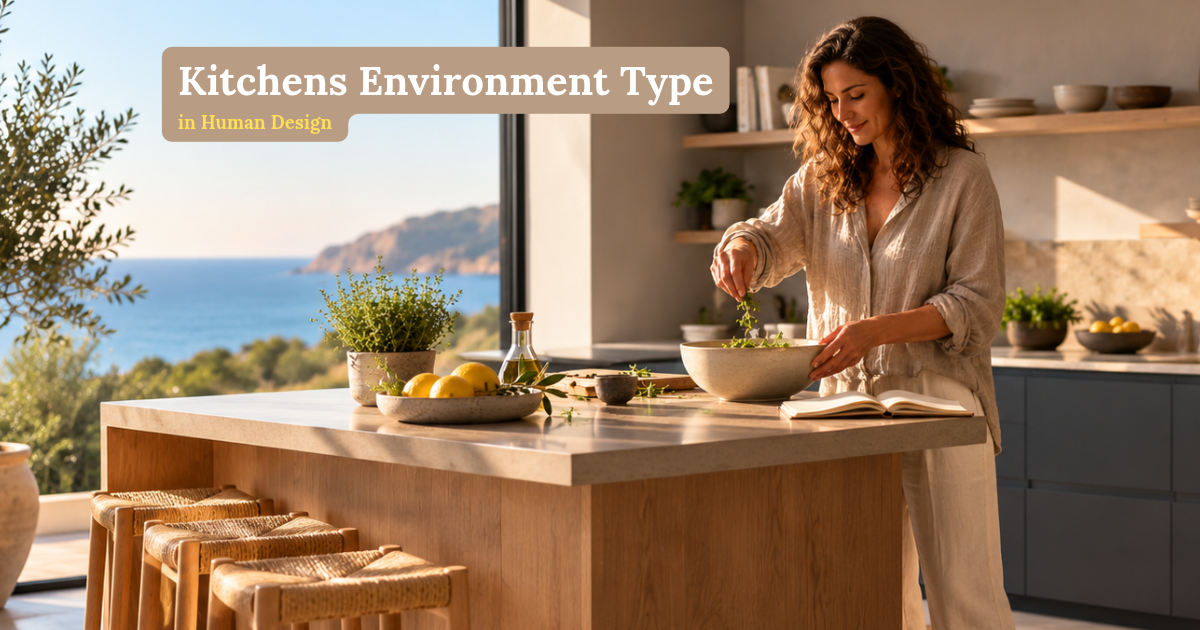
The image of a kitchen captures the essence of this Environment particularly well. A kitchen is a place where different ingredients come together and undergo transformation. Raw materials become something new through heat, movement, experimentation, and the interaction of different elements.
The process isn't always neat or predictable. Ingredients are combined, flavours are tested, adjustments are made, and sometimes the original recipe is abandoned because something more interesting emerges along the way.
Within Human Design, people with a Kitchens Environment are associated with this kind of creative transformation.
They may have a natural ability to recognise connections between ideas, people, or possibilities that others wouldn't immediately consider combining. Rather than following a predetermined formula, they often discover what works by becoming involved in the process itself.
Their creativity doesn't necessarily begin with a clearly defined outcome. Sometimes, the outcome only becomes visible once they've started experimenting.
This can be particularly valuable in situations that require original thinking, problem-solving, or the development of something that hasn't existed before.
Why Participation Matters More Than Observation
One of the central themes of the Kitchens Environment is active participation.
People with this Environment may find it difficult to develop their best ideas when they remain on the sidelines, endlessly analysing possibilities without becoming directly involved.
Their creative process often needs movement, interaction, and experimentation.
Just as a cook cannot discover the final flavour of a dish by studying the recipe alone, someone with a Kitchens Environment may need to engage with an idea before understanding what it can become.
This doesn't mean acting recklessly or abandoning careful consideration. It means recognising that some insights only emerge through experience.
They may begin with a rough idea, test an approach, notice what happens, and gradually refine their work based on what they discover.
For them, creating is not necessarily a linear progression from planning to execution. It can be an ongoing exchange between observation, action, feedback, and adjustment.
The process itself becomes an important source of information.
Understanding the Difference Between Hot and Cold
Within the Human Design interpretation of Kitchens, the distinction between hot and cold plays an important role.
This can be understood as an internal sensitivity to the energy or vitality of a particular situation.
Something that feels "hot" may appear engaging, stimulating, or full of creative potential. It draws your attention and invites you to become involved. You sense that something is happening and that your participation could contribute to its development.
Something that feels "cold", on the other hand, may no longer inspire the same interest or involvement.
This doesn't necessarily mean that the idea, project, or opportunity is objectively wrong. It may simply indicate that the creative energy you previously experienced is no longer present in the same way.
People with a Kitchens Environment may find it useful to observe these differences rather than automatically forcing themselves to continue with everything they've started.
Sometimes, the most valuable decision is to allow an idea to develop further. At other times, it may be more productive to step away and give something else your attention.
The challenge lies in recognising the difference between a temporary difficulty that requires patience and a process that no longer feels meaningful.
Why Creative Energy Often Grows Through Proximity
Another important theme of the Kitchens Environment is the presence of other people.
A kitchen is rarely just a place where ingredients are transformed. It can also be a meeting point where people work alongside one another, exchange ideas, share experiences, and contribute to something larger than their individual efforts.
For people with this Environment, proximity to others may play an important role in their creative process.
They don't necessarily need constant conversation or direct collaboration. Sometimes, simply being in a space where other people are actively creating, building, or experimenting can provide a sense of momentum.
Think of a shared workspace where several people are concentrating on different projects. Everyone is doing their own work, yet the atmosphere is alive with activity and possibility.
For someone with a Kitchens Environment, that shared sense of creation may feel more stimulating than working in complete isolation.
This doesn't mean they cannot enjoy solitude or work independently. Rather, they may benefit from finding a balance between having enough personal space and remaining connected to environments where ideas and activities are developing.
Kitchens in Business and Entrepreneurship
In business, the Kitchens Environment can be associated with an experimental and adaptive way of working.
People with this Environment may feel most engaged when they have the freedom to develop ideas, combine different approaches, and respond to opportunities as they arise.
They may enjoy creating new services, developing original concepts, or finding unexpected solutions to problems that don't fit neatly into existing categories.
Their strength may lie less in repeating a fixed process and more in recognising what a particular situation requires.
This can make their work especially valuable for clients who appreciate creativity, flexibility, and an approach tailored to their individual circumstances.
However, a business built around constant experimentation still needs a certain degree of clarity.
Clients need to understand what they're purchasing, what they can expect, and how the collaboration will work. The challenge for someone with a Kitchens Environment is therefore not to eliminate structure entirely, but to create enough structure to support their creative freedom.
A clear framework can provide stability without forcing every project or client into exactly the same process.
When that balance is present, their creativity can become a meaningful part of what makes their business distinctive.
Marketing That Reflects a Living Creative Process
Traditional marketing advice often encourages entrepreneurs to present a polished, consistent, and carefully planned image of their business.
For people with a Kitchens Environment, this approach can sometimes feel restrictive, especially when their most interesting ideas emerge spontaneously during the creative process.
They may find it more natural to share what they're exploring, developing, or discovering rather than waiting until everything is completely finished.
This could involve offering glimpses into a project, explaining how an idea developed, discussing an unexpected discovery, or inviting people to reflect on an unfinished concept.
By sharing parts of the process, they allow others to understand how they think and what makes their approach different.
This doesn't mean they need to reveal every detail of their work or maintain a constant online presence. The goal isn't to turn their entire creative life into content.
Instead, they can choose moments when sharing something feels meaningful and relevant.
For the right audience, seeing how an idea takes shape may be just as interesting as seeing the finished result.
Not Every Client Needs the Same Approach
One of the challenges for people with a Kitchens Environment can be accepting that their way of working won't appeal to everyone.
Some clients prefer a highly structured process with clearly defined stages, predictable outcomes, and detailed instructions at every step.
Others are more comfortable with an exploratory approach that allows room for unexpected discoveries and adjustments along the way.
Neither preference is inherently better than the other.
The difficulty arises when someone with a Kitchens Environment feels pressured to abandon their natural creative process in order to appeal to people who expect a completely different experience.
Trying to turn every project into a rigid formula may eventually make their work feel repetitive or uninspiring.
At the same time, allowing unlimited flexibility without communicating expectations can create uncertainty for clients.
The solution is to find people who appreciate the value of an adaptive approach while maintaining enough transparency and structure to establish trust.
When both sides understand how the collaboration works, creativity and reliability can exist comfortably alongside each other.
When the Kitchens Environment Is Out of Balance
Within Human Design, the concept of a transfer state describes a condition in which someone moves away from their natural environmental alignment.
For people with a Kitchens Environment, this may become noticeable when they spend too much time planning, analysing, or preparing without actually becoming involved in the creative process.
Ideas accumulate, possibilities are endlessly considered, and projects remain unfinished because the person keeps waiting for the perfect moment or a completely developed plan.
Sometimes, this happens because they're trying to make their process look more organised or predictable to others.
They may begin believing that they need a detailed strategy before taking even the smallest step, despite knowing from experience that their best ideas often emerge through experimentation.
Over time, this can create frustration and a feeling of creative stagnation.
Within this interpretation, reconnecting with the Kitchens Environment means allowing themselves to participate again.
That doesn't require abandoning responsibilities or making dramatic changes. It may simply involve choosing one small idea, trying something practical, or returning to an activity that feels engaging.
The intention is to restore movement between observation and action, creating opportunities for new insights to emerge through experience.
Kitchens Is About Creating Something New
The Kitchens Environment in Human Design is associated with transformation, experimentation, and the ability to bring different elements together in unexpected ways.
People with this Environment may have a particular appreciation for creative processes that remain open to change. They don't always need to know exactly what the final result will look like before beginning.
Their strength can lie in recognising possibilities, responding to what happens along the way, and allowing their ideas to evolve through direct experience.
When they create enough room for experimentation while maintaining a foundation of clarity and responsibility, their work may become both more enjoyable and more meaningful.
They don't necessarily need to choose between creativity and structure. The real opportunity lies in discovering how structure can support the kind of creative freedom that allows them to do their best work.
The essence of Kitchens is not about celebrating chaos for its own sake. It's about understanding that valuable things don't always emerge through perfectly organised or predictable processes.
Sometimes, something genuinely original appears precisely because different ideas, experiences, and influences have been allowed to come together.
And that is the transformative potential of the Kitchens Environment in Human Design.